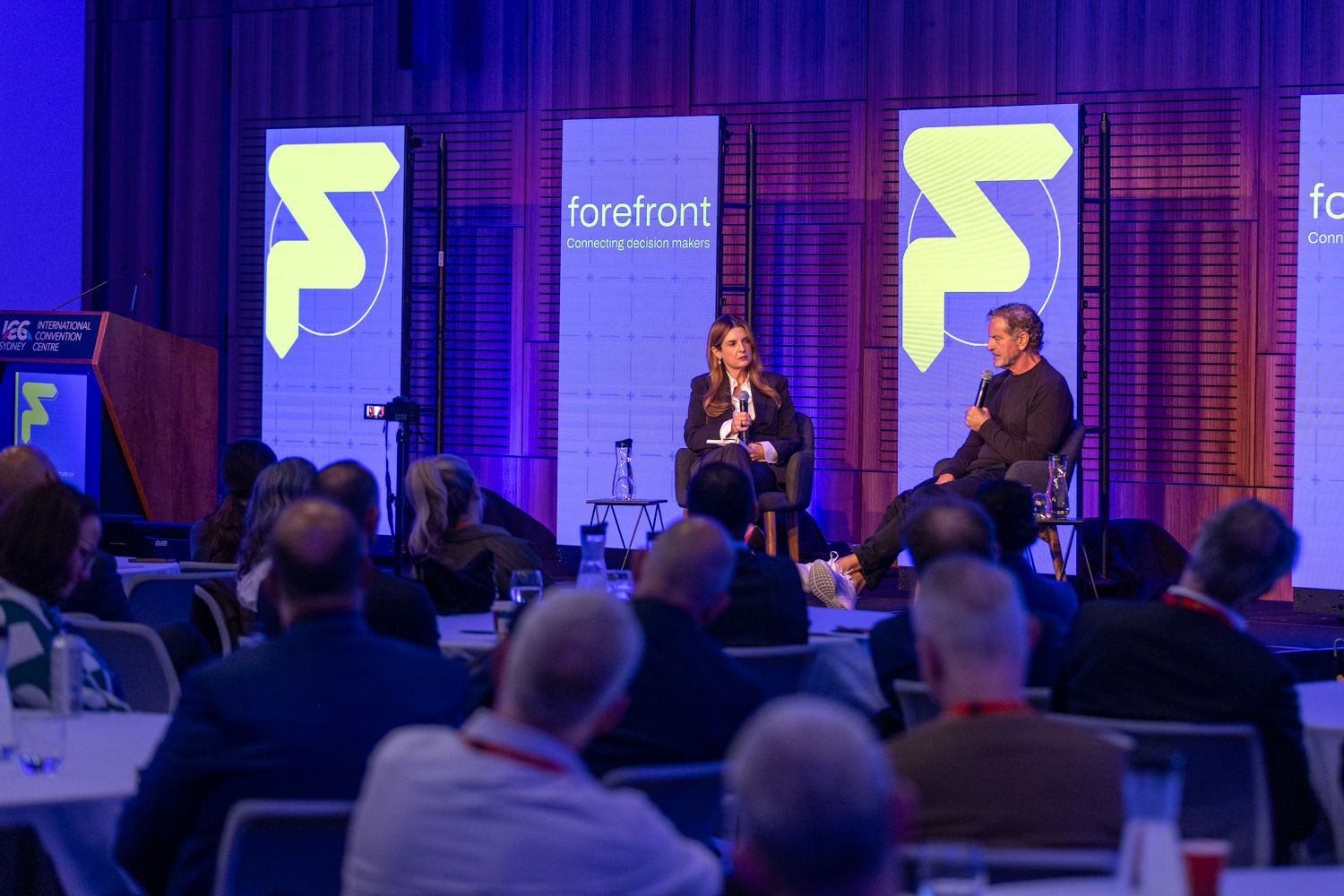
If there was one overarching theme at last month's Digital Banking Summit in Sydney, it’s that the industry has lost its appetite for isolated technology experiments. The conversations on and off stage showed that financial institutions are moving away from surface-level pilots and looking at how to build governed, end-to-end workflows that actually move the needle for their operations and customers.
The Four Shifts Reshaping Digital Banking
The conversations at the summit made it obvious that the market is rapidly moving away from fragmented, reactive tech toward intelligent orchestration. Today, four distinct trends are redefining how financial institutions approach technology design.
1. From Point Automation to Workflow Orchestration
Automating a single task inside a broken process does not change the final customer outcome. True efficiency happens when entire, connected journeys are managed from start to finish. Banks are realising that streamlining an isolated step provides minimal ROI if the broader workflow remains fragmented. The opportunity is not simply to reduce handling time at one point in the process, but to remove hand-offs, duplication and delays across the entire journey.
2. From Reactive Mobile Apps to Proactive Banking
A functional mobile app is merely the baseline today. Banks differentiate themselves by identifying a customer's real-time need and prompting the right action at the exact right moment. True engagement shifts from historical tracking to predictive guidance. This allows banks to move from servicing customer requests to anticipating needs and helping customers act before an issue arises.
3. From Manual Journey Builds to Assisted Engineering
Natural-language generation of interfaces, workflows, test cases and code is emerging as a significant productivity opportunity for engineering teams. The value will depend on whether institutions can combine faster development with disciplined testing, security controls and deployment governance.
4. From Full Automation to Human-in-the-Loop Design
The strongest use cases are not designed to remove people from banking. They use technology to absorb administrative volume and routine processing while allowing employees to focus on complex, sensitive and higher-risk interactions.
“Mid-tier banks and mutuals don’t have the budget or the risk appetite to invest in standalone AI tools that solve only a small part of the problem. The real pressure right now is on efficiency. They want to make the lending and digital workflows they already rely on smarter, without compromising the customer trust they’ve spent decades building.”
Shai Shah, Sales Director, Sandstone Technology
Moving Beyond the Copilot
Internal productivity remains the easiest starting point for most institutions. Banks naturally favour use cases where employees retain final accountability, such as drafting text, summarising files, retrieving internal knowledge, classifying documents, and supporting software testing. These tasks are straightforward to govern, proving their value without letting algorithms make uncontrolled decisions that directly impact customers.
But the market is already moving past simple copilots toward active agents. While a copilot drafts or recommends, an agent takes things a step further. It interprets an objective, gathers missing application data, initiates cases, coordinates internal teams, and prepares a final recommendation for a human to sign off on.
This distinction matters because greater autonomy requires significantly tighter controls. Institutions will need clearly defined decision rights, approval thresholds, audit trails, and clear escalation paths before these agents can be safely embedded into regulated customer journeys.
Real-Time, Contextual Personalisation
Broad marketing campaigns are rapidly losing ground to hyper-targeted prompts driven by a customer's immediate financial situation. This means sending timely alerts for things like upcoming cash shortfalls, duplicate payments, or forgotten subscriptions.
Data presented by Personetics at the summit highlights exactly why this shift is becoming urgent:
A Bankwest survey of 102 customers highlighted this exact issue around subscription management. The research found that 43% of respondents struggled to keep track of their active subscriptions, and 46% were actively paying for services they didn't use.
Consolidating this visibility helps a bank shift from a basic transactional utility to a genuinely valuable financial partner. Case studies shared during the sessions showed that this level of smart engagement led to a 30% drop in dispute-related calls while holding customer attrition to just 2%, well below the typical industry benchmark of 7% to 8%.
Designing for Real People
The summit also drove home the point that successful digital banking cannot be designed exclusively for the tech-savvy, confident user. A panel featuring leaders from Ubank, AMP Bank, Teachers Mutual Bank, and Police Bank focused heavily on accessibility, digital inclusion, and supporting customers going through financial hardship.
A central design principle came out of that discussion: customers must always have a clear, immediate route to human support and should never find themselves trapped in an automated loop. Human escalation is a mandatory design requirement, especially during stressful interactions. The system should handle the heavy lifting and gather the context before the employee steps in to help.
Turning Strategy into Reality
Translating these ideas into live production environments is a lot harder than running a successful pilot. Four foundational hurdles will ultimately determine whether institutions can scale these capabilities safely:
- Fragmented architecture: You cannot optimise a process if the underlying data and systems are siloed. Many banks still lack consistent APIs and a reliable, end-to-end operational view.
- Data quality and permissions: If customer data is incomplete, the outputs will be unreliable. Banks must strictly limit models to authorised, clean data sources.
- Explainability and auditability: Institutions need to know exactly what data went into a model, what recommendation was made, and whether a human chose to override the result.
- Operational resilience: Embedding these tools into critical, daily workflows means banks must have ironclad fallback procedures for when services inevitably face downtime.
As entrepreneur Mark Bouris emphasised in his closing remarks, technology alone does not cause disruption. Sustainable innovation requires a clearly defined customer problem, a distinct operating model, and a genuine willingness to challenge the status quo.
For financial institutions, the opportunity isn't about building a massive, general-purpose AI platform from the ground up. It is about embedding targeted intelligence, automation, and orchestration into the high-value lending, servicing, and digital workflows they already run every day.
For Sandstone Technology, the focus is on helping banks modernise those exact workflows in a practical way, boosting efficiency and customer engagement while keeping the strict governance, resilience, and human oversight that regulated banking absolutely requires.
Ready to move past tech pilots and start embedding practical intelligence into your existing setup? Whether you want to streamline a fragmented lending process or introduce smarter automation to your digital journeys, we can help. Contact us.

































.jpg)











.jpg)

.jpg)


.jpg)
.jpg)